

The Safety Frontier
Author: Dave Gajadhar
Leaders-Hive.com
February Edition 4
In 2026, the aviation industry stands at a technological crossroads. While the promise of Artificial Intelligence (AI) and automation has long been discussed in boardrooms, we have moved past the “experimental” phase into a new era: The Safety Frontier.
For C-suite executives, the mandate is no longer just about efficiency—it is about leveraging AI to build a predictive, resilient safety culture that outpaces the complexities of modern global travel.
- Moving from Reactive to Predictive Safety
Historically, aviation safety has been a “tombstone science”—learning primarily from what went wrong. AI is flipping this script. By processing terabytes of sensor data, meteorological reports, and historical incident logs in real-time, AI identifies “weak signals” that human analysts might miss.
- Predictive Maintenance (PdM): Modern AI models can now predict component failures weeks before they occur. Leading carriers report a 35% reduction in unscheduled downtime, turning potential mid-air emergencies into routine overnight repairs.
- Intelligent Safety Management Systems (SMS): AI-powered SMS now automatically categorizes hazard reports using Natural Language Processing (NLP), prioritizing high-risk trends for immediate executive intervention.
- The Flight Deck: Augmentation, Not Replacement
The conversation around “pilotless planes” often obscures the real value proposition for 2026: The Augmented Cockpit. Automation is being deployed to handle high-workload, low-cognitive tasks, allowing pilots to focus on high-level decision-making.
Key Technological Shifts:
| Feature | Traditional Automation | AI-Enhanced Frontier (2026) |
| Route Planning | Static flight paths | Dynamic optimization for fuel, weather, and turbulence. |
| Checklists | Manual/Electronic triggers | Deterministic AI that syncs with pilot actions in real-time. |
| Training | Standardized simulator hours | Adaptive Learning that identifies and fixes specific skill gaps. |
The Digital Twin: Stress-Testing the Future
One of the most significant strategic assets for today’s COO is the Digital Twin. By creating a virtual replica of entire fleet operations or airport ecosystems, leaders can run “what-if” scenarios without risking a single airframe.
- Scenario Testing: “What happens to our safety margins if we increase turnaround frequency by 10% during a storm?”
- Risk Modeling: Digital twins allow for the virtual testing of design modifications and software updates, reducing physical testing requirements by up to 40%.
The Executive Challenge: Governance & Trust
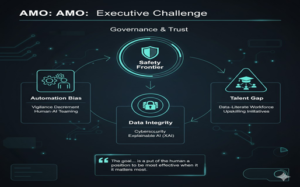
As a C-suite leader, the “Safety Frontier” presents three critical hurdles that cannot be solved by code alone:
- Automation Bias: We must guard against “vigilance decrement,” where crews become over-reliant on systems. Training must evolve to emphasize Human-AI Teaming.
- Data Integrity: AI is only as safe as the data it consumes. Robust cybersecurity and “explainable AI” (XAI)—knowing why a machine made a recommendation—are now regulatory prerequisites.
- The Talent Gap: The shift requires a workforce that is not just “tech-savvy” but “data-literate.” Investing in upskilling is now a direct investment in safety.
Executive Insight: “The goal of AI in 2026 isn’t to take the human out of the loop, but to put the human in a position to be most effective when it matters most.”
Moving from a Reactive to Predictive State:
Phase 1: Data Architecture & Integrity (Months 1–4)
AI is only as good as the data it feeds on. Most airlines have “dark data”—vast amounts of information that is collected but never utilized.
- Establish a “Data Lake”: Centralize data from Flight Data Recorders (FDR), Maintenance Logs (MRO systems), and weather telemetry into a single, high-speed repository.
- Sensor Audit: Evaluate the Quick Access Recorder (QAR) and Aircraft Condition Monitoring System (ACMS) capabilities across your fleet.
- The “Cleanliness” Standard: Implement strict data governance to ensure that manual logs (from technicians) are digitized and standardized using NLP (Natural Language Processing).
Phase 2: Pilot Programs & “Digital Twin” Modeling (Months 5–10)
Avoid the “Big Bang” implementation. Start with high-impact, high-cost systems to prove ROI quickly.
- Select “High-Yield” Components: Focus on Line Replaceable Units (LRUs) that cause the most AOG (Aircraft on Ground) events, such as APUs, environmental control systems, or engine sensors.
- Develop the Digital Twin: Create a virtual replica of these specific systems. Use historical failure data to train a Machine Learning (ML) model to recognize the “fingerprint” of a pending failure.
- Parallel Running: Run the AI model in the background. Compare its “failure predictions” against actual maintenance events to calibrate accuracy without risking flight operations.
Phase 3: Operational Integration & Trust Building (Months 11–18)
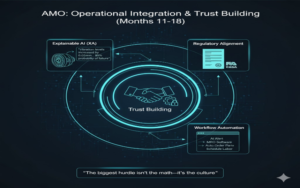
The biggest hurdle isn’t the math—it’s the culture. Your maintenance crews must trust the machine’s recommendation.
-
- Explainable AI (XAI): Ensure the software doesn’t just say “Fix Engine 2.” It must provide the rationale: “Vibration levels in Bearing X have increased by 0.05mm over 40 flight hours, indicating 85% probability of failure within 15 cycles.”
- Regulatory Alignment: Work closely with the FAA/EASA to ensure your PdM protocols meet current Continuous Airworthiness Maintenance Program (CAMP) standards.
- Workflow Automation: Integrate AI alerts directly into your MRO software (e.g., SAP, AMOS) so that parts are automatically ordered and labor is scheduled before the plane even lands.
Phase 4: Full-Scale Fleet Optimization (Month 18+)
At this stage, the AI moves from a “warning system” to a strategic asset.
- Dynamic Scheduling: Shift from fixed-interval maintenance (e.g., “every 500 hours”) to Condition-Based Maintenance (CBM). Only service parts when the data dictates, safely extending the life of components.
- Supply Chain Synergy: Use fleet-wide health data to optimize your $100M+ spare parts inventory, reducing “just-in-case” stock and freeing up capital.
- Continuous Learning Loop: Feed every “false positive” back into the model to refine the algorithm, creating a self-improving safety ecosystem.
Strategic ROI Projections
| Metric | Traditional Model | AI-Driven PdM (Projected) |
| AOG Incidents | Reactive / High Cost | 25–30% Reduction |
| Component Life | Discarded by Schedule | Optimized by Health |
| Maintenance Labor | Overtime-heavy | Predictable / Scheduled |
To launch Phase 1 (Data Architecture & Integrity), your technical leadership must bridge the gap between “big data” and “actionable intelligence.”
The following checklist is designed for your Head of Maintenance to determine if your current infrastructure can support a sophisticated AI safety model.
Section 1: Data Connectivity & Hardware
- Sensor Granularity: Does our current fleet (specifically older airframes) have the sensor density required for high-fidelity monitoring, or do we need to retrofit “Smart” Quick Access Recorders (e.g., Wireless QARs)?
- Latency Requirements: Is our data offloading process manual (via physical media), or is it automated via cellular/SATCOM immediately upon touchdown?
- The “Digital Backbone”: Do we have a unified Data Lake, or is our engine data, airframe data, and avionics data stored in disconnected “silos” owned by different OEMs?
Section 2: Data Quality & Standardization
- NLP Readiness: Are our technicians’ manual maintenance logs standardized? Can an AI read them, or is the data trapped in unstructured “free-text” fields filled with jargon and shorthand?
- Truth in Labeling: Do we have a clean historical record of “Ground Truth”—clearly labeled data points showing exactly when a component failed vs. when it was replaced?
- Sampling Rate: For critical components (like turbines), is our data sampling rate high enough to catch “transient faults” that occur in milliseconds?
Section 3: Security & Governance
- Cyber-Resilience: Does our data pipeline meet the latest DO-326A/ED-202A standards for Airworthiness Security Process?
- Ownership & Rights: Do our contracts with engine and airframe OEMs guarantee us full, unencumbered access to the raw data generated by our aircraft?
- Audit Trails: If the AI makes a maintenance recommendation that is followed, can we provide a regulatory “paper trail” explaining the logic behind that decision?
The Data Infrastructure Blueprint
To visualize how these elements connect, your CTO should be aiming for an architecture similar to this:
Next Steps for the C-Suite
The most common point of failure in this roadmap isn’t the AI—it’s the Data Silo. If your engine data is locked in an OEM’s portal and your airframe data is in a separate legacy server, your AI will be “blind” in one eye.
Conclusion: The New Standard of Excellence
Aviation has always been defined by its ability to master the impossible. Today, the “impossible” is managing the sheer volume of data generated by our operations. AI and automation are the tools that will allow us to reach the next plateau of safety.
To transition from a reactive maintenance model to an AI-Driven Predictive Maintenance (PdM) framework, the C-suite must treat the shift as an organizational transformation rather than a simple IT upgrade.
Our 4-phase strategic roadmap designed to move your fleet operations into the next generation of safety and reliability.

Contact us for more information on our workshops near you at https://leaders-hive.com/contact/